Wednesday, February 9, 2011

Great Metaphors

Just in case you need some writing inspiration. Every year, English teachers from across the USA can submit their collections of actual analogies and metaphors found in high school essays. These excerpts are published each year to the amusement of teachers across the country. Here are last year’s winners:

1. Her face was a perfect oval, like a circle that had its two sides gently compressed by a Thigh Master.

2. His thoughts tumbled in his head, making and breaking alliances like underpants in a dryer without Cling Free.

3. He spoke with the wisdom that can only come from experience, like a guy who went blind because he looked at a solar eclipse without one of those boxes with a pinhole in it and now goes around the country speaking at high schools about the dangers of looking at a solar eclipse without one of those boxes with a pinhole in it.

4. She grew on him like she was a colony of E. coli, and he was room temperature Canadian beef.

5. She had a deep, throaty, genuine laugh, like that sound a dog makes just before it throws up.

6. Her vocabulary was as bad as, like, whatever.

7. He was as tall as a six-foot, three-inch tree.

8. The revelation that his marriage of 30 years had disintegrated because of his wife’s infidelity came as a rude shock, like a surcharge at a formerly surcharge-free ATM machine.

9. The little boat gently drifted across the pond exactly the way a bowling ball wouldn’t.

10. McBride fell 12 stories, hitting the pavement like a Hefty bag filled with vegetable soup.

11. From the attic came an unearthly howl. The whole scene had an eerie, surreal quality, like when you’re on vacation in another
city and Jeopardy comes on at 7:00 p.m. instead of 7:30

12. Her hair glistened in the rain like a nose hair after a sneeze.

13. The hailstones leaped from the pavement, just like maggots when you fry them in hot grease.

14. Long separated by cruel fate, the star-crossed lovers raced across the grassy field toward each other like two freight trains, one having left Cleveland at 6:36 p.m. traveling at 55 mph, the other from Topeka at 4:19 p.m. at a speed of 35 mph.

15. They lived in a typical suburban neighborhood with picket fences that resembled Nancy Kerrigan’s teeth.

16. John and Mary had never met. They were like two hummingbirds who had also never met.

17. He fell for her like his heart was a mob informant, and she was the East River.

18. Even in his last years, Granddad had a mind like a steel trap, only one that had been left out so long, it had rusted shut.

19. Shots rang out, as shots are wont to do.

20. The plan was simple, like my brother-in-law Phil. But unlike Phil, this plan just might work.

21. The young fighter had a hungry look, the kind you get from not eating for a while.

22. He was as lame as a duck. Not the metaphorical lame duck, either, but a real duck that was actually lame, maybe from stepping on a land mine or something.

23. The ballerina rose gracefully en Pointe and extended one slender leg behind her, like a dog at a fire hydrant.

24. It was an American tradition, like fathers chasing kids around with power tools.

25. He was deeply in love. When she spoke, he thought he heard bells, as if she were a garbage truck backing up.

Monday, February 7, 2011

Gravity

The definition as described by wikipedia:
is a natural phenomenon by which physical bodies attract with a force proportional to their mass. In everyday life, gravitation is most familiar as the agent that gives weight to objects with mass and causes them to fall to the ground when dropped. Gravitation causes dispersed matter to coalesce, thus accounting for the existence of the Earth, the Sun, and most of the macroscopic objects in the universe. Gravitation is responsible for keeping the Earth and the other planets in their orbits around the Sun; for keeping the Moon in its orbit around the Earth; for the formation of tides; for natural convection, by which fluid flow occurs under the influence of a density gradient and gravity; for heating the interiors of forming stars and planets to very high temperatures; and for various other phenomena observed on Earth.


Gravitation is one of the four fundamental interactions of nature, along with the strong force, electromagnetism and the weak force. Modern physics describes gravitation using the general theory of relativity, in which gravitation is a consequence of the curvature of spacetime which governs the motion of inertial objects. The simpler Newton's law of universal gravitation provides an accurate approximation for most calculations.


What would you do without gravity? The simple attraction  you have to a simple object carries a gravity. Without that attraction you would be left with almost nothing to look at or consider. Gravity will cause you to fall and it can cause you to get lifted. When you can display a high gravity toward a situation or person, that person or situation therefore tends to shift it's current direction toward your gravitational pull. It may be similar to why the stars in the sky 'twinkle'. Not only is the flickering caused my the atmosphere, it is also caused by gravity. Imagine a star 100 light years away, well there is probably 1,000,00 stars, planets, and other masses that the light from that star must pass by before it reaches your eye. Every mass the light passes..even nearby..will cause a slight pull on the light ray, making that light shift to the left or right by just micrometers..even if that. This pushing and pulling of the line light ray through space causes it to appear to twinkle.
Same goes with that situation, see your size is relative. Imagine all the millions upon billions of atoms and small space masses between your self and a situation or person. Is there a greater difference in the distance between situations and your self or another person and yourself? Maybe not by much. But all the either small or large gravities will effect the way a situation is handled. So be careful in the how much worry you put on a situation or be careful is how hard you may be on someone. Because a misunderstanding can come in any form and sometimes the people you love are very close and they will want to have a better understanding of how much you love them, or just simply want you to know they love you.
Gravity can be anything you want it to be. It is an extremely weak force in comparison to greater forces in the universe (strong, weak, electromagnitism).  
 

The Center of Gravity

The military Jeep was said
to have had a high center
of gravity, therefore
subject to tipping:
if you took a curve too fast
you might turn over.
A person with very short legs
has a low center of gravity
and will not tip over easily.
The ottoman likewise.
When a person is lying flat
he or she has the lowest center
of gravity possible, as does
a sheet of paper on a table.
People floating around
in outer space have little
or no center of gravity
because there's not enough gravity
to have a center.
Gravidanza is the Italian word
for pregnancy, which sounds
more serious than the English word
and may remind us of sentences such as
"The situation is very grave."
Every situation has gravity,
it's a question of how much.
People too have gravity—
of manner, of morals, and of body.
It is good to have gravity
but not too much of it:
like a bag of cement,
you might not be able to move
around or make ethical distinctions.
But with too little of it
you are flighty, your feet
hardly touch the ground.
Though cement and flightiness
have their charms,
it's better to find
your center of gravity
and have it be the place
you radiate out from.

Once I lay in bed ill, unable to move,
but in my head
I was flying and bouncing around.
But illness has no charm
and when it becomes very grave
your gravity edges toward
the most perfect center of gravity ever.

Tuesday, February 1, 2011

Modified Grill w/ Propane Unit and even distribution smoke

All this strange weather is bringing in some strange ideas...

First, some consideration tunes:


Venison ground burger>diced jalapenos>diced sweet 1/16th sweet onion>dales and some jalapenos juice + one egg= marinating.....

More to come

Here is what I have started with:


This is what I have done to it so far:

Installed a propane unit for when people are over I can keep the meat warm, also great for just cooking some bread or long term potatoes.


This is the heat damper covering the firebox opening. The the opening I turn over the drip plate and made where the heat can enter then be distributed throughout both side of the smoker evenly.


Then what you have here is the chimney has been moved to be level with the meat. Otherwise the heat rises and exist the upper corner, now it is forced to circulate prior to exhaust.

Monday, January 31, 2011

OSHA, regulations or no? Bureacratic nonsense or helpful big brother?

Well now then you have some states that have adopted OSHA to regulate for themselves and there are states that allow the OSHA to regulate. In the states that regulate their own OSHA program, there could be a discriminatory enforcement toward certian sectors of the labor force and business groups. At this level, the On the federal level, the local clout could presumably sway the inspectors systematically therefore providing a heavy weighted business concentration towards one way or another. That is, excessive labor supply and weak business and job availability or weak labor supply and stong business. The two extremes may also be viewed as strong, compentent and high output labor with weak business or the opposite.

Now in the states where OSHA is the at the federal level and have little or no control over the OSHA regulatory process, there may exist a more stable balance between business and labor force.

So then, thereoretically the agency will act accordingly toward their own agendas while managing the directions of the policy implementations in order to better satisfy their agendas. The agendas being the goals of OSHA to futher their agency and better fund their programs.

But if you ask me personally, I think OSHA has their head on their shoulders. You may view the agency as a big brother with big muscles and the authority to flex those muscles and tell you what to do and when to do any action as they see fit. But this big brother has all the information, resources, research and intellegency to watch out for you and yours.

What would you rather have? A jobsite without any regulations where everything is sorta willy nilly? Or a jobsite where workers are required to wear hearing protection, wear steel toe boots, check their electrical cords for breaks or tears..ect. Me, I would rather have someone watching my back (low risk) then work in an unregulated environment.. place of higher risk

Saturday, January 29, 2011

Linus Sings The Police better quality.mov

This is goood stuff.

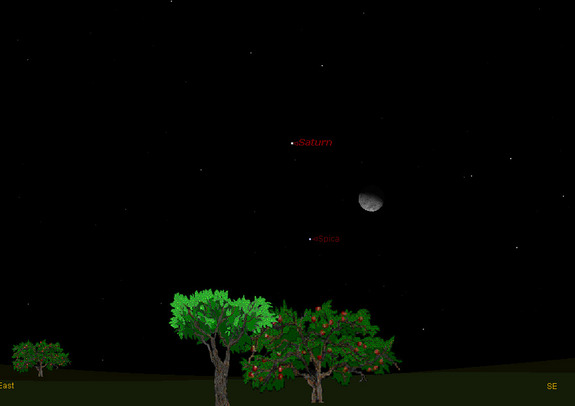
Tonight, Moon, Saturn and a bright star form triangle


Skywatchers who are out and about past the witching hour of midnight tonight (Jan. 24) will have an interesting celestial array to admire: a cosmic triangle created by the moon, the planet Saturn and a bright star.

To stargazers, the sky configuration will initially resemble a rather large isosceles triangle low in the east-southeast sky, weather permitting.

The triangle's three points begin with the moon – which should be not quite two-thirds illuminated in its waning gibbous phase. [How Moon Phases Work]

Up next is Saturn, appearing as a sedate, yellowish-white glow well above and to the left of the moon. The bright, bluish star Spica completes the triangle at an end point below and to the left of the moon, in the zodiacal constellation of Virgo.

The moon, of course, appears to pass Spica every month as it crosses the sky, but at this particular moment Saturn happens to be nearby, too, forming a sort of "Saturn Triangle."

This sky map of the Saturn Triangle shows how it will appear to stargazers with clear, dark skies in the first hours of tomorrow.

What makes this triangle isosceles (with two sides of equal length) is that Saturn will be located at an equal distance from both the moon and Spica: about 8 degrees of the sky.

Astronomers measure distances between objects in the night sky based on degrees of arc. For example, your clenched fist held at arm’s length will cover about 10 degrees.

So the Saturn-moon and Saturn-Spica sides of the triangle will be slightly less than a fist’s width in length. The side of the triangle from the moon to Spica will measure just 6 degrees.

By around 5:30 a.m. EST tomorrow (1030 GMT), just as dawn is about to break on the eastern U.S. coast, the trio will have moved to a point nearly halfway up in the sky toward the south. But the triangle will also look a bit different.

Saturn is currently 859 million miles (1.382 billion kilometers) from Earth and will not change its position relative to the background stars during the course of a single night. But the moon is only 228,700 miles (368,000 km) away, and as a result will slowly shift its position to the east during the course of the night.

In fact, less than six hours after the triangle’s first appearance, the moon will have appeared to move about 3 degrees closer to Spica, causing the triangle to become narrower.

(The moon appears to move east against the background stars at roughly its own apparent width — half a degree — per hour.)

Astronomers measure the brightness of objects in the sky use a magnitude scale. The lower the number, the brighter an object appears. The full moon, for example, has a magnitude of about -12.7 on this scale.

Saturn, at a magnitude of 0.6, is roughly a half magnitude brighter than the star Spica.

If you have a telescope, check out Saturn's rings. Just 16 months ago, Saturn's rings were all but invisible to us because they were turned edge-on (or nearly so) as viewed from Earth. Now, however, they are tilted just over 10 degrees toward us and are readily seen if you are using a magnification of at least 30-power.
-from Space.com

Tuesday, January 25, 2011

Widespread Panic New Years Eve 2001


Father and Son Launch iPhone Into Space

Like many youngsters, and those young at heart, seven-year-old Max Geissbuhler and his dad dreamed of visiting space -- and armed with just a weather balloon, video camera, and an iPhone, in a way they did just that. The father and son team from Brooklyn managed to send their homemade spacecraft up nearly 19 miles, high into the stratosphere, bringing back perhaps the most impressive amateur space footage ever.

Homemade Spacecraft from Luke Geissbuhler on Vimeo.

The duo housed the video camera, iPhone, and GPS equipment in a specially designed insulated casing, along with some hand-warmers and a note from Max requesting its safe return from whomever may find it after making it back to solid ground. All told, father and son spent eight months preparing for their homemade journey into space, in hopes of filming "the blackness beyond our earth".

Then, one day in August, Max and his father headed out to a nearby park to see their dreams realized. After attaching their equipment to a 19 inch weather balloon and switching on the camera, they watched as their simple craft disappear high into the sky.

After a little over an hour, the craft reached the stratosphere, 100 thousand feet overhead, capturing some incredible footage of space before the balloon popped and fell back towards earth. They found their spacecraft 25 miles away from where they had let it go, stuck up in a tree.

Although the camera's battery died some minutes before touching-down, the footage it returned is no short of impressive. And despite the fact that the craft didn't technically reach the boundaries of space, Max and his father are undoubtedly proud of their accomplishment.

Geissbuhler describes the experience on the video he uploaded to the Internet:

In August 2010, we set out to send a camera to space. The mission was to attach a HD video camera to a weather balloon and send it up into the upper stratosphere to film the blackness beyond our earth. Eventually, the balloon will grow from lack of atmospheric pressure, burst, and begin to fall.

It would have to survive 100 mph winds, temperatures of 60 degrees below zero, speeds of over 150 mph, and the high risk of a water landing. To retrieve the craft, it would need to deploy a parachute, descend through the clouds and transmit a GPS coordinate to a cell phone tower. Then we have to find it.

Needless to say, there are a lot of variables to overcome.

Just as the space-race of the 1960s was driven by a spirit of exploration and ingenuity, so too was the bold idea of Max and Luke Geissbuhler to film the darkness beyond our planet with their homemade spacecraft. And just as mankind was at once emboldened by the success of science and the realm of possibility was widened for an entire generation -- perhaps this father and son team can inspire others to follow their dreams, too, do-it-yourself style.


Homemade Spacecraft from Luke Geissbuhler on Vimeo.

Monday, January 24, 2011

Geocaching

Placed my first geocache today in the TWRA Percy Priest area. Geocaching is a high-tech treasure hunting game played throughout the world by adventure seekers equipped with GPS devices. The basic idea is to locate hidden containers, called geocaches, outdoors and then share your experiences online. Geocaching is enjoyed by people from all age groups, with a strong sense of community and support for the environment.

The History of Geocaching


On May 2, 2000, at approximately midnight, eastern savings time, the great blue switch* controlling selective availability was pressed. Twenty-four satellites around the globe processed their new orders, and instantly the accuracy of GPS technology improved tenfold. Tens of thousands of GPS receivers around the world had an instant upgrade.

The announcement a day before came as a welcome surprise to everyone who worked with GPS technology. The government had planned to remove selective availability - but had until 2006 to do so. Now, said the White House, anyone could "precisely pinpoint their location or the location of items (such as game) left behind for later recovery." How right they were.
London, Paris, New York, Beavercreek?

For GPS enthusiasts, this was definitely a cause for celebration. Internet newsgroups suddenly teemed with ideas about how the technology could be used.

On May 3, one such enthusiast, Dave Ulmer, a computer consultant, wanted to test the accuracy by hiding a navigational target in the woods. He called the idea the "Great American GPS Stash Hunt" and posted it in an internet GPS users' group. The idea was simple: Hide a container out in the woods and note the coordinates with a GPS unit.

The finder would then have to locate the container with only the use of his or her GPS receiver. The rules for the finder were simple: "Take some stuff, leave some stuff."

On May 3rd he placed his own container, a black bucket, in the woods near Beavercreek, Oregon, near Portland. Along with a logbook and pencil, he left various prize items including videos, books, software, and a slingshot. He shared the waypoint of his "stash" with the online community on sci.geo.satellite-nav:

N 45° 17.460 W 122° 24.800

Within three days, two different readers read about his stash on the Internet, used their own GPS receivers to find the container, and shared their experiences online. Throughout the next week, others excited by the prospect of hiding and finding stashes began hiding their own containers and posting coordinates. Like many new and innovative ideas on the Internet, the concept spread quickly - but this one required leaving your computer to participate.

Within the first month, Mike Teague, the first person to find Ulmer's stash, began gathering the online posts of coordinates around the world and documenting them on his personal home page. The "GPS Stash Hunt" mailing list was created to discuss the emerging activity. Names were even tossed about to replace the name "stash" due to the negative connotations of that name. One such name was "geocaching."
The Origins of Geocaching

Geocaching, first coined by Matt Stum on the "GPS Stash Hunt" mailing list on May 30, 2000, was the joining of two familiar words. The prefix geo, for Earth, was used to describe the global nature of the activity, but also for its use in familiar topics in gps such as geography.

Caching, from the word cache, has two different meanings, which makes it very appropriate for the activity. A french word invented in 1797, the original definition referred to a hiding place someone would use to temporarily store items. The word cache stirs up visions of pioneers, gold miners, and even pirates. Today the word is still even used in the news to describe hidden weapons locations.

The second use of cache has more recently been used in technology. Memory cache is computer storage that is used to quickly retrieve frequently used information. Your web browser, for example, stores images on disk so you don't have to retrieve the same image every time you visit similar pages.

The combination of Earth, hiding, and technology made geocaching an excellent term for the activity. However the "GPS Stash Hunt" was the original and most widely used term until Mike Teague passed the torch to Jeremy Irish in September 2000.
The Birth of Geocaching.com

For the first few months, geocaching was confined to existing experienced GPS users who already used the technology for outdoor activities such as backpacking and boating. Most users had an existing knowledge of GPS and a firm grasp of obscure lingo like datums and WGS84. Due to both the player base and the newness of the activity, players had a steep learning curve before going out on their first cache hunt. Tools were scarce for determining whether a cache was nearby, if one existed at all.

As with most participants, Jeremy Irish, a web developer for a Seattle company, stumbled upon Mike Teague's web site in July while doing research on GPS technology. The idea of treasure hunting and using tech-gadgets represented the marriage of two of his biggest interests. Discovering one was hidden nearby, Jeremy purchased his first GPS unit and went on his first hunt the following weekend.

After experiencing the thrill of finding his first cache, Irish decided to start a hobby site for the activity. Adopting the term geocaching, he created Geocaching.com and applied his professional web skills to create tools to improve the cache-hunting experience. The cache listings were still added by hand, but a database helped to standardize the listings. Additional features, like searching for caches around zip codes, made it easier for new players to find listings for nearby caches.

With Mike Teague's valuable input, the new site was completed and announced to the stash-hunting community on September 2, 2000. At the time the site was launched there were 75 known caches in the world.
If You Hide It, They Will Come

Slashdot, a popular online magazine for techies, reported the new activity on September 25, 2000, introducing a larger group of technology professionals to the activity. The New York Times picked up the story and featured it in its "Circuits" section in October, starting a domino effect of articles written in magazines, newspapers, and other media outlets around the world. CNN even did a segment in December 2000 to profile the new hobby.

However, because there were so few caches in the world, many would-be participants discovered they didn't have a cache listed nearby. Many wondered whether anyone would bother looking for a cache if they hid one in their area. The growing community chanted the mantra "If you hide it, they will come" to the newer players. After some reassurances, pioneers of the hobby started placing caches just to see whether people would go find them. They did.

Through word of mouth, press articles, and even accidental cache discoveries, more and more people have become involved in geocaching. First started by technology and GPS enthusiasts, the ranks of geocachers now include couples, families, and groups from all walks of life. The excitement of the hunt appeals to both the inner (and outer) child. Today you can do a search on just about anywhere in the world and be able to walk, bike, or drive to a nearby hidden cache.
The Creation of Groundspeak

After the increased traffic from Slashdot, Irish realized that the ongoing management of the web site would quickly grow out of the lone computer on his home DSL line. So in late 2000, he partnered with Elias Alvord and Bryan Roth, two coworkers at Sunrise Identity, to start a new company called Groundspeak Inc. (originally "Grounded Inc."). With the proceeds from sales of 144 geocaching t-shirts, they moved the machines into a hosted environment in downtown Seattle. The founders continued to work for Sunrise Identity while managing the new company and the web site in their off hours.

After several years of working on the web site, Jeremy and Elias were able to raise enough through Premium Memberships to make Groundspeak a full time job. In late 2005, Bryan Roth finally became a full time employee at the company.

Jeremy Irish, Elias Alvord and Bryan Roth continue to own and operate the web site today. They are supported by a small team of Groundspeak Lackeys and over 100 geocaching volunteers worldwide.